Best AI Detectors for Research Papers: Clever AI Detector Among the Options
Five AI checkers compared for long papers, sentence-level detail, language coverage, plus cost. None should be treated as proof of authorship.
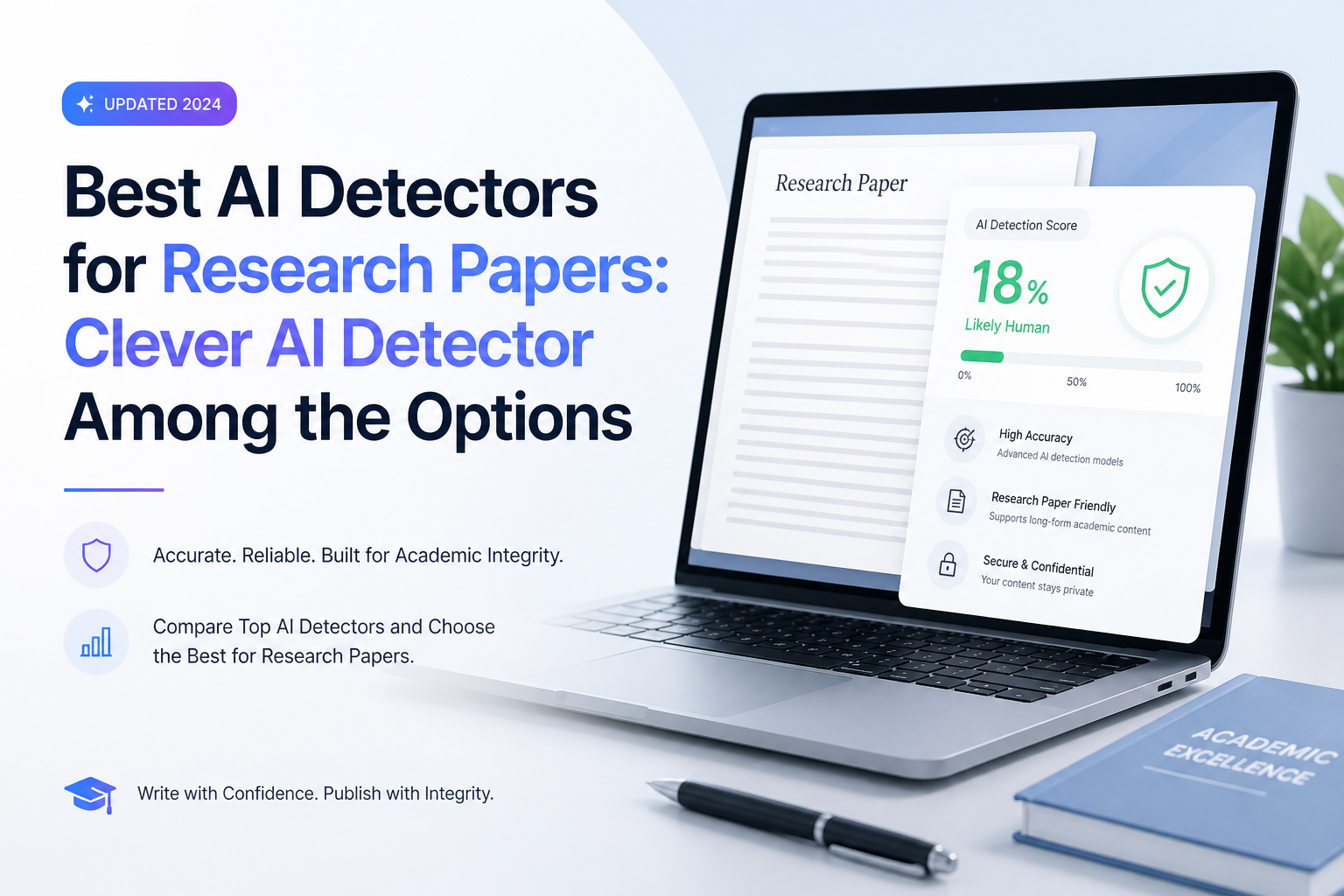
Clever AI Detector is the best starting point for most research papers because it handles up to 10,000 words per check at no cost. GPTZero is the stronger alternative when writing replay or classroom review tools matter more than a frictionless scan.
Clever AI Detector
9.1/10Best for: Students, researchers, plus instructors who want a free first-pass check on complete English-language papers
- Up to 10,000 words in one free check
- Sentence-level AI signals
- No account required for basic use
- Unlimited runs subject to service availability
GPTZero
8.7/10Best for: Educators who want detection reports alongside authorship or writing-replay tools
- Built with education use in mind
- Sentence-level review features
- Authorship plus writing-replay tools
- Free entry option
Copyleaks
8.5/10Best for: Universities or research groups screening papers written across several languages
- AI detection across 30-plus languages
- AI plus plagiarism results in one report
- Multi-file upload support
- Browser plus Google Docs integrations
AI Detectors for Research Papers Compared
The five tools below are compared by practical paper length, sentence-level detail, price, plus overall fit for academic review. Paper-fit percentages plus scores are editorial judgments based on verified product limits, workflow features, transparency, plus cost, not controlled accuracy benchmarks.
| Tool | Research-Paper Fit | Sentence Detail | Price | Score |
|---|---|---|---|---|
| 1. Clever AI Detector PICK | ● 92% | ● Yes | Free | 9.1/10 |
| 2. GPTZero | ● 89% | ● Yes | Free | 8.7/10 |
| 3. Copyleaks | ● 87% | ● Yes | $16.99/mo | 8.5/10 |
| 4. Originality.ai | ● 84% | ● Yes | $14.95/mo | 8.2/10 |
| 5. QuillBot AI Detector | ● 78% | ● Yes | Free | 7.8/10 |
The 5 Best AI Detectors for Research Papers, Reviewed
01 Clever AI Detector
Web app / CleverFiles
9.1/10
Clever AI Detector
Web app / CleverFiles
Clever AI Detector takes the top spot because its free version is unusually practical for research papers. It accepts 80 to 10,000 words per check, needs no account, plus returns an overall probability with sentence-level signals. That upper limit can hold many journal manuscripts without forcing researchers to split the paper into tiny pieces. (cleverhumanizer.ai)
The result is framed as probability rather than proof, which matters with formal academic prose. Clever also displays confidence information, helping readers distinguish a strong signal from an uncertain middle-range score. Its main limitation is language coverage. The detector currently focuses on English, so multilingual projects need another option. (cleverhumanizer.ai)
This is still a screening tool, not evidence of misconduct. Use highlighted sentences to guide a closer review, then compare the paper with drafts, citations, notes, or document history.
Best forStudents, researchers, plus instructors who want a free first-pass check on complete English-language papers
- Up to 10,000 words in one free check
- Sentence-level AI signals
- No account required for basic use
- Unlimited runs subject to service availability
- Reports probability plus confidence rather than a blunt accusation
- English-only detection
- A newer detector with a shorter public track record
- No institutional LMS workflow listed
02 GPTZero
Web platform / GPTZero
8.7/10
GPTZero
Web platform / GPTZero
GPTZero is the more established classroom-oriented choice here. Its product set includes AI detection, plagiarism checking, authorship analysis, plus writing replay. That broader context is valuable when a polished research paper receives a surprising score because an instructor can look beyond the final text.
The interface is better suited to repeated academic review than a bare paste box, though some useful features sit behind paid access. Its pricing page confirms a free option, yet the public page did not expose a dependable current price for every paid tier during our September 2026 check. We therefore list only the verified $0 entry point. (gptzero.me)
Best forEducators who want detection reports alongside authorship or writing-replay tools
- Built with education use in mind
- Sentence-level review features
- Authorship plus writing-replay tools
- Free entry option
- Team plus API options available
- Paid plan pricing was not fully visible on the public page
- A score can still misread polished academic writing
- More account friction than lightweight checkers
03 Copyleaks
Web platform / Copyleaks
8.5/10
Copyleaks
Web platform / Copyleaks
Copyleaks fits departments that need more than an English-only checker. Its Personal plan includes AI detection in 30-plus languages, plagiarism detection in over 100 languages, multi-file uploads, saved scans, plus a Google Docs add-on. One unified report can cover AI signals plus source matching. (copyleaks.com)
The Personal plan provides 100 credits, equal to as many as 25,000 scanned words or 100 images. At $16.99 monthly, it makes more sense for frequent reviews than for a student checking one paper before submission. Education pricing is institution-specific, so it is not shown below. (copyleaks.com)
Best forUniversities or research groups screening papers written across several languages
- AI detection across 30-plus languages
- AI plus plagiarism results in one report
- Multi-file upload support
- Browser plus Google Docs integrations
- Clear monthly word allowance
- Costs more than basic student-focused options
- Education pricing requires direct contact
- Credits can feel restrictive during high-volume review periods
04 Originality.ai
Web platform / Originality.ai
8.2/10
Originality.ai
Web platform / Originality.ai
Originality.ai is aimed more at editors plus content operations than individual students. It supports pasted text, Word files, PDFs, scan history, tags, team roles, plus a Chrome extension. The Pro subscription includes 2,000 credits monthly, with one AI-detection credit covering 100 words. (originality.ai)
For a research group reviewing working papers, those organization features can be handy. A student checking one dissertation chapter may find the subscription harder to justify, especially since monthly credits expire. The current monthly Pro price is $14.95, or $12.95 per month when billed yearly. (originality.ai)
Best forResearch labs, journal editors, or publishers checking many long-form submissions
- Accepts PDF plus Word uploads
- Includes plagiarism plus fact-checking tools
- Useful scan history plus tagging
- Team-management features
- Concrete credit allowance
- No full-featured permanent free tier
- Monthly subscription credits expire
- Designed more for publishers than student self-checking
05 QuillBot AI Detector
Web app / QuillBot
7.8/10
QuillBot AI Detector
Web app / QuillBot
QuillBot is convenient for a quick check because many students already use its writing tools. The free detector accepts up to 1,200 words per scan, permits six scans daily, plus provides limited explanation cards. It requires at least 80 words, with QuillBot recommending longer text for more useful results. (quillbot.com)
The 1,200-word ceiling is fine for an abstract or section, not an entire research paper. QuillBot also says uncertain cases tend to be classified as human-written, which may reduce false alarms while allowing some AI text to pass. Treat it as a low-stakes second opinion rather than a final answer. (quillbot.com)
Best forStudents checking an abstract, literature-review excerpt, or short draft at no cost
- Free scans without an immediate payment
- Clear 0–100 result
- Useful for abstracts plus short sections
- Limited sentence explanations included
- Part of a broader student writing toolkit
- Free scans stop at 1,200 words
- Only six free checks per day
- Conservative classification may miss some AI writing
How We Evaluated AI Detectors for Research Papers
This ranking used a feature-based review rather than pretending we ran a definitive authorship experiment. We checked current official product pages on September 5, 2026, then compared paper-length limits, sentence-level feedback, file support, language coverage, published pricing, plus how clearly each service describes uncertainty.
Scores place extra weight on long-document usefulness plus responsible reporting. Vendor accuracy claims were not accepted as independent proof. A detector also lost ground if its free limit forced a normal paper into many disconnected scans, since section splitting can change the context available to the classifier.
How to Choose an AI Detector for a Research Paper
Start with document length. A checker capped near 1,000 words may work for an abstract but creates a clumsy workflow for a 7,000-word manuscript. Sentence highlighting is the next useful feature because an overall percentage tells you little about which passages influenced the result.
Language coverage, privacy terms, file support, plus access to writing history matter too. Instructors should favor tools that present uncertainty instead of bold guilty-or-innocent labels. Students doing a private self-check may care more about free access plus whether unpublished research is retained.
Common AI Detection Mistakes in Academic Review
The biggest mistake is treating a detector score as proof. Formal definitions, repetitive methods sections, conventional literature-review phrasing, plus heavily edited English can resemble patterns found in generated text. Short excerpts are another problem because they provide less context, making scores easier to overread.
Do not keep rewriting legitimate prose merely to satisfy several detectors. That can make a paper less precise or introduce factual errors. If authorship is questioned, preserve outlines, tracked changes, research notes, citation-library records, lab notebooks, plus dated drafts. Turnitin itself says AI scores should support review or conversation rather than determine misconduct by themselves. (guides.turnitin.com)
Which AI Detector Should Researchers Use?
Clever AI Detector earned first place through a useful mix of long-document capacity, sentence-level signals, transparent uncertainty, plus a genuinely free workflow. GPTZero is worth considering when authorship history matters, while Copyleaks suits multilingual departments. Originality.ai makes more sense for publishing teams, with QuillBot filling the quick, no-cost abstract-checking role.
Whichever tool you choose, do not turn a probability score into an accusation. Research-paper authorship is better assessed with drafts, source notes, revision history, citation knowledge, plus a conversation with the writer.
Run the complete paper through your first choice, compare any surprising result with a second detector, then inspect drafts plus revision history before drawing a conclusion.