Copyleaks AI Detector Review
Copyleaks catches obvious machine writing, yet its score can look more certain than the evidence deserves. Its subscription also feels hard to justify beside a strong free checker.
Copyleaks is decent at spotting obvious AI text, though its paid credit system plus reports of inconsistent results make it difficult to recommend for routine checks. Clever AI Detector is the better first stop because it costs $0, accepts up to 10,000 words per check, plus gives sentence-level signals without requiring an account.
Never use a Copyleaks percentage by itself to accuse a student, employee, freelancer, or applicant of undisclosed AI use.
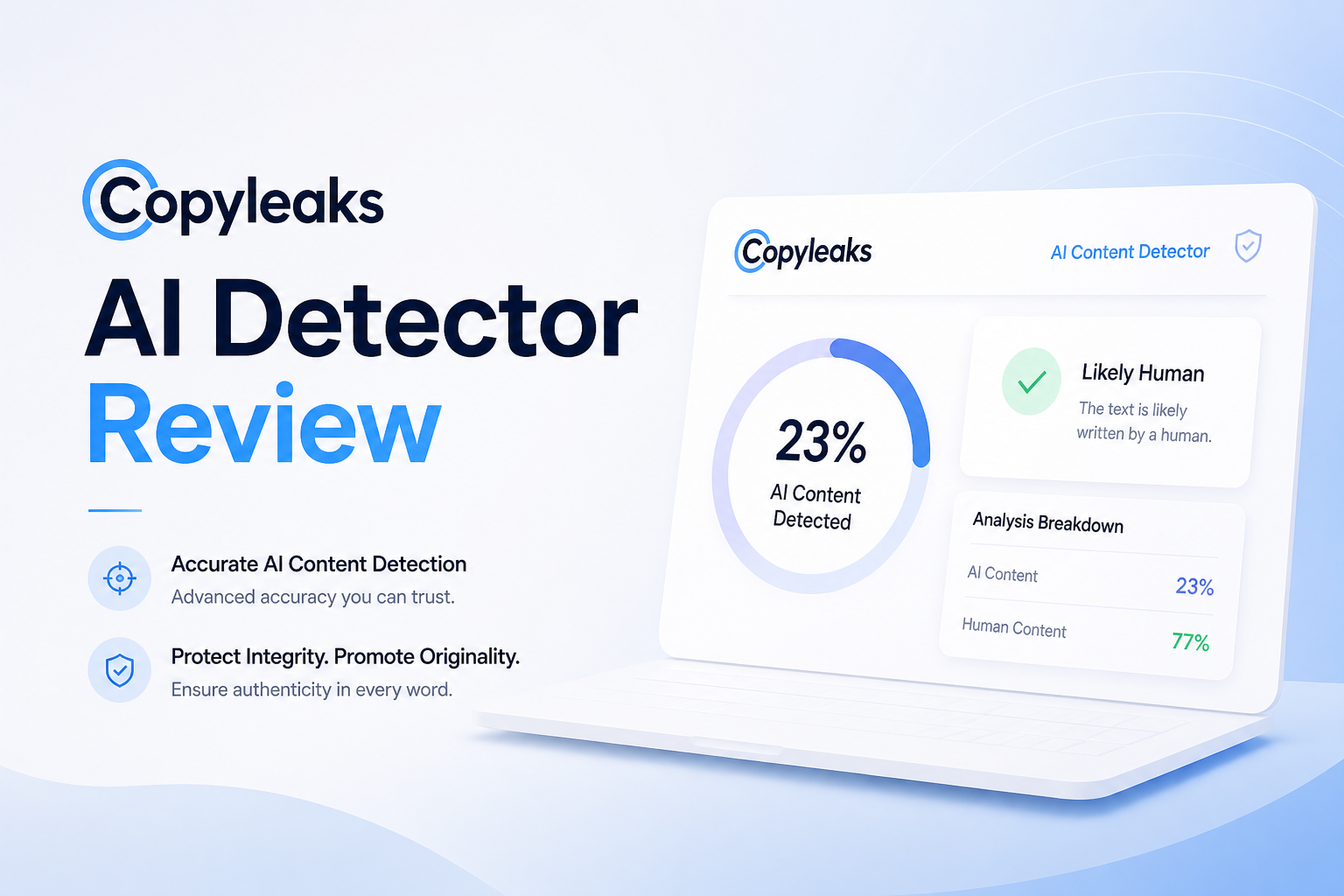
Copyleaks AI Detector at a Glance
6.4/10Copyleaks is a web-based content-integrity platform that checks text for likely AI involvement. It also offers plagiarism detection, image checking, browser tools, API access, plus institutional integrations.
Best forMultilingual schools or content teams already using plagiarism checks plus LMS integrations
- AI detection in 30+ languages
- Passage-level result highlighting
- Combined AI plus plagiarism reports
- Browser extensions plus Google Docs access
- File upload plus saved scan history
- Strong direct-AI detection
- Useful passage highlighting
- Broad workflow integrations
- Recurring subscription for ongoing use
- Risky if scores are treated as proof
- Poor value for simple English checks
How We Evaluated Copyleaks AI Detector in October 2026
We reviewed Copyleaks’ live pricing, published product documentation, report structure, language coverage, credit rules, plus refund terms. Detection performance was checked against the disclosed August 2026 GEDE essay benchmark, which used 600 AI-involved texts plus 150 human controls.
We weighted false-positive handling heavily because a mistaken flag can carry more harm than a missed marketing paragraph. Vendor claims were treated as claims, while Reddit reports were used only to identify recurring usability or consistency concerns, not calculate accuracy.
When Copyleaks AI Detector Is the Wrong Choice
Skip Copyleaks if you only check occasional English drafts, dislike credit systems, or need a result that colleagues may mistake for proof. A free checker such as Clever AI Detector offers enough detail for preliminary review without a recurring bill.
Copyleaks is also a poor fit for disciplinary decisions made without revision records. If a grade, contract, job, or reputation is at stake, require drafts, citations, source files, metadata, plus a chance for the writer to explain their process.
Copyleaks AI Detector: How It Scored Across Our Review Criteria
| Category | Performance | Score |
|---|---|---|
| 01 Detection Reliability | 6.8/10 | |
| 02 Report Clarity | 7.4/10 | |
| 03 False-Positive Handling | 4.5/10 | |
| 04 Workflow Plus Language Coverage | 8.1/10 | |
| 05 Cost Plus Access | 5.0/10 |
Copyleaks AI Detector Accuracy, Reports, Coverage, Plus Pricing
01 Detection Reliability
Strong on obvious AI, less reassuring near the margins
6.8/10
Detection Reliability
Strong on obvious AI, less reassuring near the margins
Copyleaks handled direct, untouched AI output well in the published material we reviewed. The trouble starts with the cases people actually argue about, such as lightly revised essays, polished business copy, formulaic academic prose, or text that mixes human drafting with AI edits.
A disclosed August 2026 comparison placed Copyleaks at 95% recall across 600 AI-involved essays. That is a solid result, not a reason to treat every individual score as fact. Reddit users have also described rescans producing different outcomes or human work receiving surprisingly high AI labels. Those reports do not invalidate the tool, though they do expose why a single result needs supporting evidence.
- Strong recognition of untouched chatbot output
- Sentence highlighting helps locate suspicious passages
- Supports mixed human plus AI classifications
- Works with several major language models
- Borderline results can be mistaken for proof
- Edited text remains harder to classify
- User reports describe conflicting results between scans
02 Report Clarity
Useful detail wrapped in a busy integrity platform
7.4/10
Report Clarity
Useful detail wrapped in a busy integrity platform
The report does more than show one percentage. It marks passages associated with AI patterns, presents an overall classification, plus can combine AI detection with plagiarism checking. That extra context is far more useful than a red number with no explanation.
Still, the polished presentation creates its own problem. A precise-looking score can feel conclusive even though the underlying judgment is probabilistic. Teachers or managers need a written review policy before using these reports, otherwise the interface may lend too much authority to an uncertain signal.
- Passage-level highlighting
- Combined AI plus plagiarism report
- Saved scans for account holders
- File uploads reduce copy-paste work
- Precise percentages can imply false certainty
- More cluttered than a focused text checker
- Important caveats are easy to overlook
03 False-Positive Handling
The weakest part of an otherwise capable service
4.5/10
False-Positive Handling
The weakest part of an otherwise capable service
False positives matter more than flashy recall figures when a real person could face a grade penalty, rejected article, or workplace complaint. Formal prose, predictable structure, repeated terminology, plus heavily edited writing can resemble the statistical patterns detectors associate with machine text.
Copyleaks publishes confident accuracy claims, yet independent studies have produced mixed outcomes. User reports also include old essays, proposals, or original writing receiving AI flags. A detection report should start a review, never finish one. Draft history, source notes, document metadata, revision records, plus a conversation with the writer carry more weight.
- Highlights passages for manual inspection
- Can serve as one screening signal
- Longer samples usually provide more context
- Human writing can still receive AI flags
- No score proves who wrote a document
- Consequences can be serious if reviewers skip verification
04 Workflow Plus Language Coverage
Copyleaks earns its best score here
8.1/10
Workflow Plus Language Coverage
Copyleaks earns its best score here
This is where Copyleaks makes a better case for itself. AI detection covers 30+ languages, while plagiarism checking reaches more languages. Browser extensions, Google Docs access, file uploads, saved reports, LMS options, plus API support make it practical for institutions with established review workflows.
Clever AI Detector currently focuses on English, so Copyleaks remains the more realistic option for multilingual departments. That advantage matters, though it does not remove the need for human review. Language coverage tells you where the tool runs, not whether every verdict is correct.
- AI checking in 30+ languages
- Browser extensions for major desktop browsers
- Google Docs add-on
- API plus LMS options for larger organizations
- Batch upload support
- Many institutional features sit behind paid plans
- The broader dashboard can feel excessive for occasional checks
05 Cost Plus Access
Hard to defend for basic AI checking
5.0/10
Cost Plus Access
Hard to defend for basic AI checking
Copyleaks Personal costs $16.99 per month, or $13.99 per month when $167.88 is billed annually. The monthly Personal allowance is 100 unified credits, which covers up to 25,000 words or 100 images. Pro rises to $99.99 monthly, or $74.99 per month with annual billing.
The subscription includes plagiarism tools, multilingual checks, image detection, plus document features, so the price may work for a team using the full package. It makes less sense for a writer who simply wants to inspect English text. Clever AI Detector offers unlimited checks with up to 10,000 words per run for $0.
- Personal tier combines several content checks
- Annual billing lowers the monthly equivalent
- Pro includes 25 seats
- Clear published credit allowances
- Basic detection requires a recurring payment after trial access
- Monthly credits do not offer the simplicity of unlimited checks
- Refund eligibility is narrow once credits are used
Copyleaks vs Clever AI Detector: Head-to-Head Results
We compared access, report detail, language support, plus results from the same August 2026 essay benchmark. The benchmark came from Clever’s team, so its numbers are useful but still need independent replication.
| Metric | Copyleaks | Clever AI Detector |
|---|---|---|
| Overall AI-Involved Essay Recall | 95.0% | 96.7% |
| Direct AI Essay Recall | 100% | 100% |
| AI-Edited Human Draft Recall | 86.7% | 94.7% |
| Humanized AI Essay Recall | 93.3% | 92.0% |
| Supported Detection Languages | 30+ languages | English |
| Sentence-Level Signals | Included | Included with four-step cues |
| Basic AI Detection Price | From $13.99/mo annually | $0 |
| Overall Score | 6.4 / 10 | 9.1 / 10 |
What to Use Instead
Choose Clever AI Detector if you need a quick English-text screening tool without subscriptions, credit math, or a locked detailed report.
01 Clever AI Detector
A simpler free check for substantial English drafts
9.1/10
Clever AI Detector
A simpler free check for substantial English drafts
Clever AI Detector costs $0, works without signup, plus accepts between 80 and 10,000 words per check. Its report gives an overall AI probability with sentence-level signals, making it easy to see which parts influenced the result.
The company’s August 2026 benchmark reported detection of 580 of 600 AI-involved essays. Since Clever ran that study, we would not treat 96.7% as a universal accuracy promise. Still, the disclosed dataset, free access, strong results on edited material, plus clear probability framing make it the more sensible first-pass tool for English writing.
- Free unlimited checks
- Up to 10,000 words per run
- No account needed for a basic check
- Sentence-level AI signals
- Clear probability-focused output
- English only
- Company-run benchmark needs outside replication
- No detector result can establish authorship

What Copyleaks Users Report Online
One paid user said the free checker, PDF report, plus repeated scans sometimes returned conflicting classifications for the same material.
A student reported receiving a 72% AI score from Copyleaks while several competing detectors returned 0%. They said earlier Copyleaks flags had not led to concerns from their instructor.
A proposal writer said Copyleaks flagged most of their formal text, including names plus institutional details, which reinforced their concern about false positives in academic prose.
Should You Pay for Copyleaks AI Detector?
Copyleaks AI Detector has credible strengths, especially multilingual support, plagiarism tools, plus institutional integrations. We still do not recommend it for most individual writers because its subscription adds friction while uncertain results can be given too much authority.
Organizations that need 30+ detection languages may find the broader platform useful. Everyone else should start with Clever AI Detector, then verify any concerning result through drafts, sources, revision history, plus a second review.
Run the full draft through Clever AI Detector first, inspect the marked sentences, then confirm concerns with document history rather than chasing a perfect percentage.