Best WiFi Site Survey Software in 2026
Five tools stood out for mapping coverage, planning access points, or validating real-world WLAN performance. NetSpot offers the most balanced package for typical IT work.
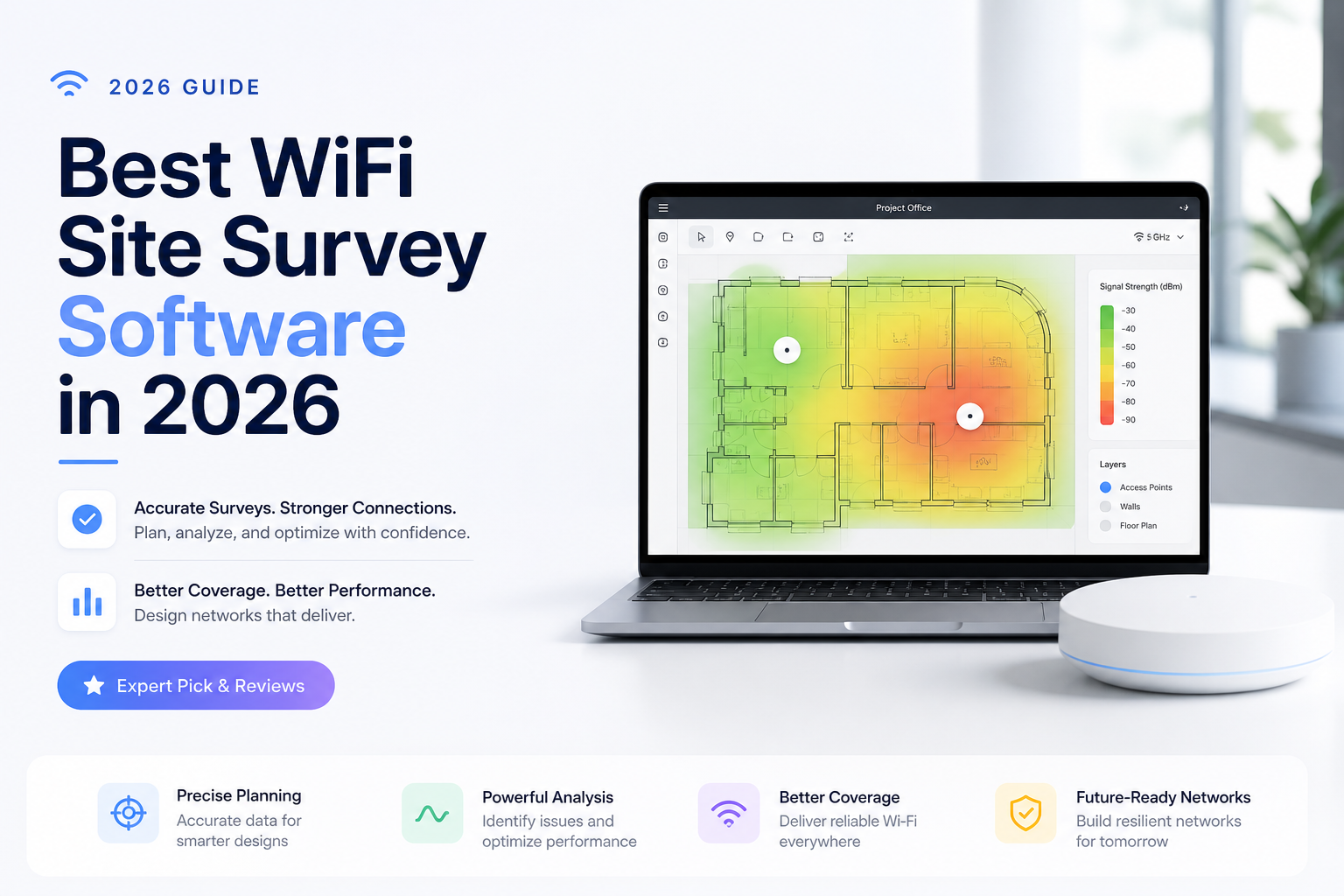
NetSpot is the best WiFi site survey software for most buyers in 2026. Its mix of measured heatmaps, predictive planning, plus live WiFi inspection covers common home, office, plus consulting jobs without requiring a costly proprietary sensor.
NetSpot
9.2/10Best for: IT staff, consultants, plus small teams that need real surveys without enterprise-level hardware costs
- Runs on Windows, macOS, plus Android for cross-platform fieldwork
- Includes measured surveys plus predictive planning in PRO
- Displays more than 20 survey visualizations
- Uses standard compatible WiFi hardware for common survey work
Hamina Network Planner
8.8/10Best for: Wireless engineers designing multi-floor WiFi before access points are installed
- Strong predictive modeling for WiFi 7 deployments
- Works in a browser with interactive project sharing
- Models multi-floor spaces in 2D or 3D
- Includes wired infrastructure planning
TamoGraph Site Survey
8.6/10Best for: Network professionals who need passive RF maps, throughput testing, plus optional spectrum analysis
- Supports passive, active, predictive, plus spectrum survey workflows
- Available for Windows plus macOS
- Offers six-month, one-year, or perpetual Pro licenses
- GPS mode suits outdoor campus surveys
Best WiFi Site Survey Software Compared
These five tools are compared by predictive-planning support, desktop platform coverage, published US pricing, plus overall usefulness. Scores reflect editorial judgment based on workflow, feature depth, cost, hardware requirements, plus licensing rather than a universal RF accuracy benchmark.
| Tool | Predictive Planning | Desktop Platforms | Price | Score |
|---|---|---|---|---|
| 1. NetSpot PICK | ● Yes | Windows, macOS | $199 one-time | 9.2/10 |
| 2. Hamina Network Planner | ● Yes | Web browser | $980/yr | 8.8/10 |
| 3. TamoGraph Site Survey | ● Yes | Windows, macOS | $999/yr | 8.6/10 |
| 4. Acrylic WiFi Heatmaps | ● Yes | Windows | $129/mo | 8.1/10 |
| 5. VisiWave Site Survey | ● No | Windows | $379/yr | 7.7/10 |
The 5 Best WiFi Site Survey Software Tools, Reviewed
01 NetSpot
Windows, macOS, Android / Etwok
9.2/10
NetSpot
Windows, macOS, Android / Etwok
NetSpot earned first place by covering the whole basic workflow without forcing buyers into a costly hardware bundle. Its desktop PRO edition supports 23 measured heatmap types, unlimited AP visualization, customizable reports, plus 9 predictive visualizations.
The project limits are sensible for independent consultants or in-house IT teams: PRO permits 50 zones, 50 snapshots per zone, plus 500 measurement points per snapshot. During our workflow review, its separation of Inspector, Survey, plus Planning modes made the route from a quick channel check to a mapped survey unusually easy to follow.
The main compromise is depth at the high end. Large WLAN consultancies may still need dedicated spectrum hardware, more detailed capacity modeling, or tighter vendor-platform integrations. For most offices, schools, shops, plus multi-AP homes, though, NetSpot gives the cleanest mix of useful features, approachable operation, plus price.
Best forIT staff, consultants, plus small teams that need real surveys without enterprise-level hardware costs
- Runs on Windows, macOS, plus Android for cross-platform fieldwork
- Includes measured surveys plus predictive planning in PRO
- Displays more than 20 survey visualizations
- Uses standard compatible WiFi hardware for common survey work
- One-time PRO license costs far less than most specialist suites
- Free edition is mainly useful for inspection or product evaluation
- Advanced RF troubleshooting may require separate spectrum hardware
- PRO limits can feel tight on stadium-scale or very large campus projects

02 Hamina Network Planner
Web platform / Hamina Wireless
8.8/10
Hamina Network Planner
Web platform / Hamina Wireless
Hamina is the strongest option here for people whose work starts before a technician walks the site. The paid Planner tier supports WiFi 7 modeling, unlimited AP placement, multi-floor buildings, 2D plus 3D reporting, plus automated recognition of walls, elevators, or shelving.
Its browser interface also makes project sharing easier than passing desktop survey files between machines. Wired-network design is included, so planners can map switches, IDFs, MDFs, plus cable routes beside the RF model.
The catch is easy to miss: the $980-per-year Planner plan focuses on predictive design. Onsite measurement requires Hamina's separate survey kit. That division works well for design specialists, though it makes Hamina less attractive for someone seeking one inexpensive app for occasional walk-through surveys.
Best forWireless engineers designing multi-floor WiFi before access points are installed
- Strong predictive modeling for WiFi 7 deployments
- Works in a browser with interactive project sharing
- Models multi-floor spaces in 2D or 3D
- Includes wired infrastructure planning
- Free account offers a practical way to inspect the interface
- Planner subscription does not include onsite surveying
- Annual cost exceeds NetSpot PRO's one-time price
- Best results require careful wall-material plus scale inputs
03 TamoGraph Site Survey
Windows, macOS / TamoSoft
8.6/10
TamoGraph Site Survey
Windows, macOS / TamoSoft
TamoGraph is built for deeper field validation. Both Standard plus Pro support passive surveys, active throughput surveys, plus spectrum surveys when compatible analyzer hardware is connected. Reports can be produced as PDF, HTML, or ODT files.
The Pro release adds predictive RF modeling, GPS-assisted outdoor collection, plus report customization. It also lists support for modern 802.11be WiFi 7 networks, making it a better fit than older survey utilities for current commercial deployments.
Cost is the main obstacle. A six-month Pro license is $499, while a perpetual Pro license reaches $1,999 before optional adapters or spectrum hardware. Still, active measurement plus flexible licensing give contractors a credible way to equip themselves for a short run of projects.
Best forNetwork professionals who need passive RF maps, throughput testing, plus optional spectrum analysis
- Supports passive, active, predictive, plus spectrum survey workflows
- Available for Windows plus macOS
- Offers six-month, one-year, or perpetual Pro licenses
- GPS mode suits outdoor campus surveys
- Exports reports in several useful formats
- Predictive modeling is excluded from Standard
- Spectrum analysis requires compatible extra hardware
- Interface has a steeper learning curve than NetSpot
04 Acrylic WiFi Heatmaps
Windows / Tarlogic
8.1/10
Acrylic WiFi Heatmaps
Windows / Tarlogic
Acrylic WiFi Heatmaps takes a practical hardware-friendly approach. Basic includes unlimited surveys, 11 heatmap types, WiFi 7 planning, all three modern frequency ranges, automatic coverage validation, plus editable reports.
Advanced raises the count to 15 heatmap types, then adds monitor mode, spectrum-analyzer integration, connected-client identification, plus SNR analysis. Its published support for more than 250 adapters is useful for technicians who already own compatible Windows survey gear.
Licenses range from one month to perpetual access. A short Basic job starts at $129 for one month, which is handy for a one-off redesign. Continued use gets expensive, though, while the Windows-only setup rules it out for Mac-centered teams.
Best forWindows-based survey technicians who want broad external adapter support plus short license terms
- One-month licenses suit occasional paid projects
- Supports 2.4, 5, plus 6 GHz planning
- Advanced offers monitor mode plus client identification
- Editable reports are included
- Broad compatible adapter list
- Windows only
- Perpetual licenses are expensive
- Advanced features cost noticeably more than Basic
05 VisiWave Site Survey
Windows / Crestview Group Holdings
7.7/10
VisiWave Site Survey
Windows / Crestview Group Holdings
VisiWave keeps field collection simple: load a floor plan, walk the property, then click locations as the WiFi adapter records nearby AP data. Continuous collection is available, while GPS support handles outdoor areas such as campuses, campgrounds, or municipal hotspots.
The current license costs $379 per year, including updates plus support. It accepts PNG, PDF, JPEG, GIF, or BMP floor plans, then exports coverage findings as PDFs or images for clients.
There are two notable limits. VisiWave is Windows-only, plus its evaluation build intentionally randomizes collected readings. That means the 30-day trial is suitable for learning the interface, not for making real AP-placement decisions.
Best forWindows users collecting indoor walk-through surveys plus GPS-tracked outdoor coverage data
- Supports manual, continuous, plus GPS-based collection
- Works with standard compatible Windows WiFi adapters
- Creates live heatmaps during collection
- Exports client-friendly PDFs plus images
- Annual price is lower than many specialist suites
- Windows only
- Evaluation readings are deliberately randomized
- Predictive design is less central than in Hamina or TamoGraph
How We Evaluated the Best WiFi Site Survey Software for 2026
We compared each tool's July 2026 desktop support, survey modes, predictive-planning features, heatmap range, reporting, hardware needs, trial restrictions, plus published US pricing. The review also followed a common project path: importing or drawing a scaled floor plan, checking AP data, mapping coverage, reviewing interference views, then preparing a report.
Scores favor tools that handle more of that workflow without proprietary hardware or confusing license jumps. We did not treat vendor heatmap counts as proof of better RF accuracy, since measurement quality also depends on the adapter, device orientation, walking route, floor-plan scale, plus sample spacing.
How to Choose WiFi Site Survey Software for Your Network
Start with the survey type. A predictive survey estimates coverage before installation, a passive survey records nearby RF activity, while an active survey checks real traffic performance. Small offices often need passive mapping plus a basic plan. Warehouses, schools, hospitals, or dense venues may need all three.
Next, check the boring details that can stop a project cold: operating-system support, compatible adapters, 6 GHz visibility, maximum project size, report formats, commercial-use rights, plus whether a free edition saves usable data. A cheap scanner is not a bargain if it cannot export the map your installer needs.
Common WiFi Site Survey Software Mistakes to Avoid
Do not compare tools solely by the number of heatmaps. Several visualizations may show closely related versions of signal strength, while a less flashy tool might provide the active throughput test or GPS collection your job actually requires.
Also avoid collecting every point with a laptop held in different positions. Use a consistent device height plus orientation, set the map scale carefully, walk both sides of thick walls where possible, then repeat questionable areas. Software can smooth sparse readings into a convincing picture, but it cannot repair careless source data.
Which WiFi Site Survey Tool Should You Choose?
NetSpot wins because it covers live inspection, measured heatmaps, plus predictive planning without the price or hardware burden of a specialist enterprise suite. Its interface also makes sense to occasional users, not just trained wireless engineers.
Choose Hamina if predictive design is your main job. TamoGraph is better for deeper active validation, Acrylic suits Windows technicians with compatible adapters, while VisiWave remains useful for straightforward GPS-assisted outdoor work.
Download the trials for your top two choices, import the same scaled floor plan, then confirm that each tool supports your WiFi adapter plus the reports your client or manager expects.