How to Rewrite AI Content Naturally
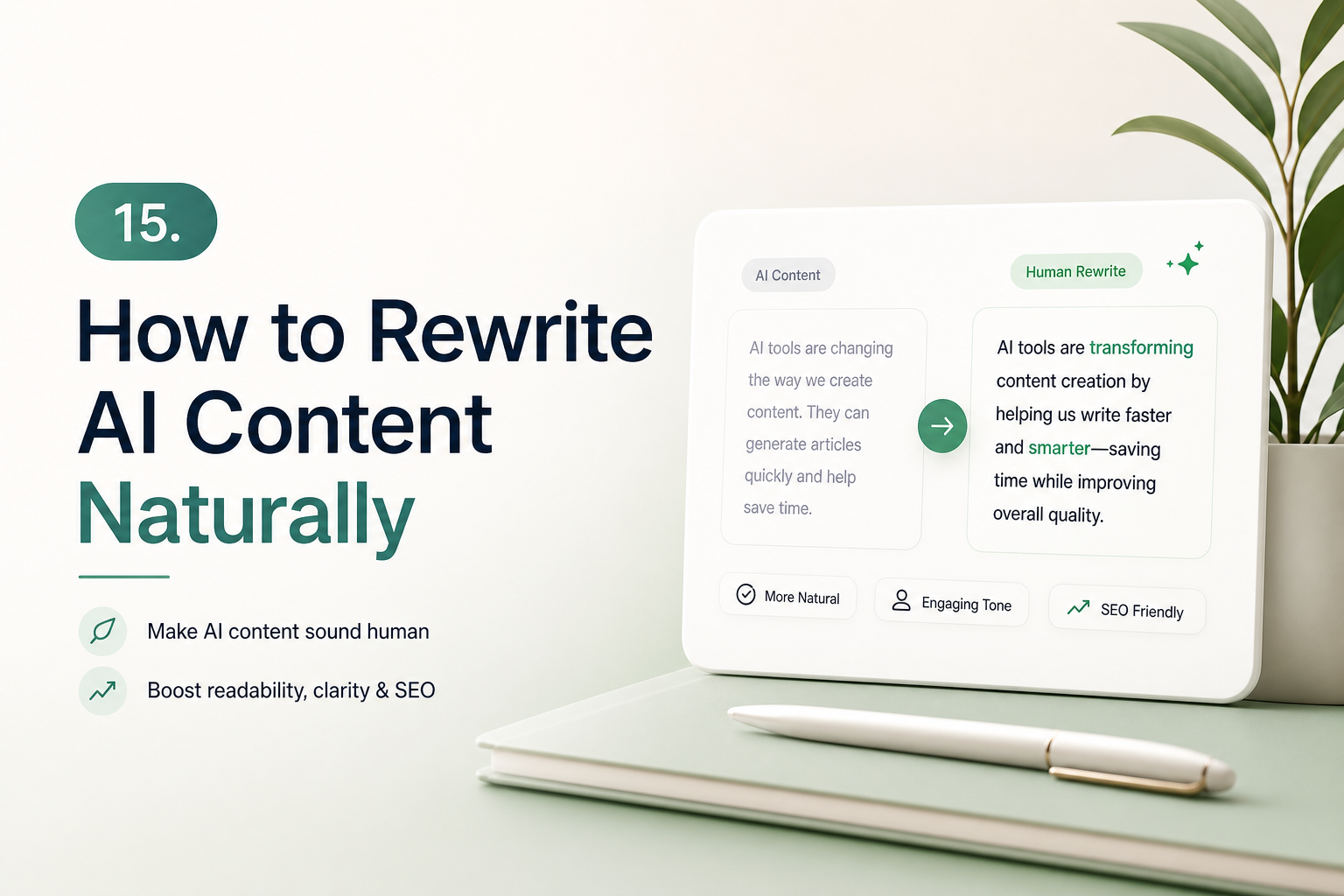
A natural rewrite is more than swapping synonyms. These five methods fix rhythm, structure, vague language, plus the small patterns that make a draft feel generated.
Start with a focused Clever AI Humanizer pass, then edit the result yourself. Check every fact, rewrite repetitive paragraph openings, plus read the final version aloud before publishing.
Do not use rewriting tools to disguise plagiarism or break school, workplace, publishing, or platform rules. Keep source citations, verify factual claims, plus disclose AI use whenever the relevant policy requires it.
Humanize a Stiff First Draft → Clever AI Humanizer
Handles up to 3,000 words per request · Normal mode targets conversational flow · Runs in a web browser
When an AI Humanizer Is the Wrong First Step
Skip automated rewriting when the source draft contains unsupported claims, copied passages, weak research, or a structure that misses the reader's question. A humanizer may smooth the wording while leaving the real problem untouched.
Fix the argument first. Verify the evidence, remove repetition, then decide whether a tool-based language pass would save meaningful time.
Choose the Right Method to Rewrite AI Content Naturally
Pick the lightest edit that fixes the actual problem.
| Method | Best for | Time | Success rate |
|---|---|---|---|
| 1. Run a focused pass with Clever AI Humanizer TRY FIRST | Stiff but accurate drafts | ~3 min | ● 88% |
| 2. Rewrite every paragraph opening | Repetitive structure | ~8 min | ● 82% |
| 3. Replace vague claims with specific details | Generic or shallow copy | ~12 min | ● 90% |
| 4. Edit the draft by ear | Awkward sentence rhythm | ~15 min | ● 86% |
| 5. Rebuild the draft from a lean outline | Deep structural problems | ~30 min | ● 95% |
Top 5 Methods to Rewrite AI Content Naturally
01 Run a focused pass with Clever AI Humanizer
Fastest for a useful draft that still sounds stiff or predictable
~3 min
Run a focused pass with Clever AI Humanizer
Fastest for a useful draft that still sounds stiff or predictable
Clever AI Humanizer gives a stiff draft a more conversational rhythm without making you rebuild every paragraph. It works best on text that is already accurate, organized, plus close to your intended meaning.
- Save a copy of the original draft so you can restore any facts or phrasing that gets lost.
- Open Clever AI Humanizer, then paste one section of 300 to 800 words.
- Choose the Normal writing style for a natural, conversational result.
- Run the humanizer, then compare the new version with your source paragraph by paragraph.
- Restore precise terms, names, figures, citations, plus any wording that carries a specific meaning.
- Read the result aloud once. Shorten any sentence that makes you run out of breath.

02 Rewrite every paragraph opening
Useful when the draft repeats the same setup across the page
~8 min
Rewrite every paragraph opening
Useful when the draft repeats the same setup across the page
AI drafts often begin paragraphs with tidy transitions, broad claims, or mini summaries. Changing only those openings can make the whole piece feel less mechanical while preserving most of the useful material.
- Highlight the first sentence of every paragraph.
- Delete openings that merely announce the topic, such as phrases that say a subject is important or worth considering.
- Start each paragraph with a concrete point, consequence, example, question, or contrast.
- Vary the opening length. A four-word sentence beside a longer one creates a less uniform pace.
- Remove transition words that explain an obvious connection between neighboring paragraphs.
- Check that each revised opening still leads naturally into the sentences that follow.
03 Replace vague claims with specific details
Best for generic writing that could apply to almost any reader
~12 min
Replace vague claims with specific details
Best for generic writing that could apply to almost any reader
Natural writing usually contains choices, limits, small examples, plus details that reflect a real situation. Generic statements feel automated because they avoid committing to anything concrete.
- Underline claims built around vague words such as many, various, effective, or important.
- Replace each weak claim with a verified fact, realistic example, named feature, observed behavior, or clear limitation.
- Add one practical detail a reader could use, such as a menu label, file type, time estimate, or likely mistake.
- Explain why the detail matters instead of leaving it as decoration.
- Remove examples that you cannot verify or would not comfortably defend.
- Review citations after the rewrite so every source still supports the surrounding sentence.
04 Edit the draft by ear
Good for text that is correct on screen but awkward when spoken
~15 min
Edit the draft by ear
Good for text that is correct on screen but awkward when spoken
Your ear catches repeated sentence shapes, packed clauses, plus unnatural transitions faster than a silent grammar check. This pass focuses on rhythm rather than chasing a casual tone everywhere.
- Read the draft aloud at your normal speaking speed, or play it through a text-to-speech tool.
- Mark every spot where you pause unexpectedly, lose the point, or feel tempted to rephrase.
- Split sentences that contain several equally weighted ideas.
- Combine short sentences when the passage starts sounding clipped or list-like.
- Replace formal connectors with direct relationships between ideas. In some places, remove the connector entirely.
- Repeat the read-aloud pass until the wording feels comfortable without extra effort.
05 Rebuild the draft from a lean outline
Most reliable when the original structure feels generic from top to bottom
~30 min
Rebuild the draft from a lean outline
Most reliable when the original structure feels generic from top to bottom
Some AI drafts have problems below the sentence level. If every section follows the same predictable pattern, extract the useful ideas, close the draft, then write from a short outline.
- Copy only the essential facts, examples, requirements, plus source references into a separate note.
- Reduce each section to one sentence stating what the reader needs to learn or do.
- Reorder the outline around the reader's likely questions instead of preserving the generated structure.
- Hide the original draft, then write each section from the outline in your normal vocabulary.
- Reopen the source draft to recover any useful detail you missed, not its sentence structure.
- Finish with a factual review plus a light grammar check.
Which AI Rewrite Method Should You Use?
Start with Clever AI Humanizer when your draft already contains the right information but needs a smoother, less predictable voice. Follow it with a factual check plus a quick read-aloud pass.
If the problem is generic detail, use method three. If the entire piece feels formulaic, rebuilding from an outline will usually produce a cleaner result than endless sentence-level polishing.
Keep the untouched draft beside the rewrite so you can restore exact facts, useful phrases, plus source context before publishing.